

How To Install Bronze Bushings
To utilise our Press-Fit Bushing Hole Size Calculator click here.
Recommended Bit Clearance:
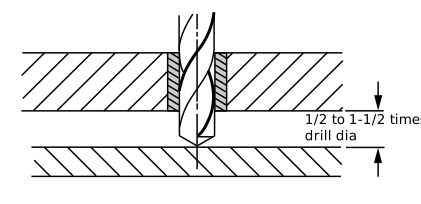
To minimize drill bending and maximize pigsty accurateness, mountain drill bushings as close to the workpiece as possible while still allowing acceptable chip clearance. The necessary clearance depends on workpiece material and chip stringiness. For example, cast iron, with fine fries requires about 1/two times drill diameter for flake clearance. Materials that produce long, stringy chips, such as common cold-rolled steel and aluminum, require at least one-drill-diameter clearance. To reduce clearance even with long, stringy fries, exit-stop flake breakers are bachelor.
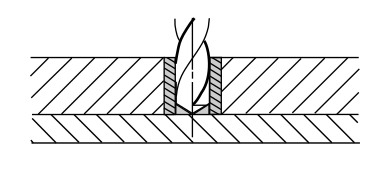
Direct workpiece contact is usually not recommended. Chips tin escape only up through the drill'south flutes, drill-bearing length is shortened by the drill point'southward length, and drill-withdrawal burrs can raise the jig plate. Direct contact may exist necessary, though, for maximum bearing length when drilling sloped surfaces (see below). Also, reamer bushings can be mounted much closer than drill bushings, due to much effectively chips, for more-accurate hole finishing.
Sloped Workpiece Surfaces:
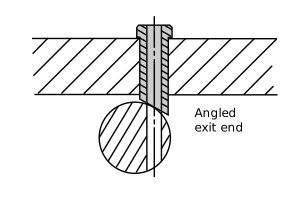
Whenever the drilling axis is non perpendicular to the workpiece surface, locate the exit terminate as close to the part as possible. Otherwise the drill will tend to wander. For maximum drill guiding, nosotros recommend specifying bushings with an angle milled on the leave end, tangent to the workpiece surface at point of entry.
Special Bushings for Close Hole Spacing:
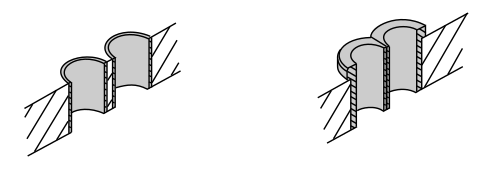
When holes are located close together, special bushings are sometimes required. Thinwall bushings, where the bushing ID is larger than the normal ID range for a given OD, are ofttimes a practiced solution. Holes for thinwall bushings must be very accurate and round, because these bushings are more-easily distorted. For very-close hole spacing, peculiarly with headed bushings, specify bushings with ground flats.
Installation-Pigsty Preparation:
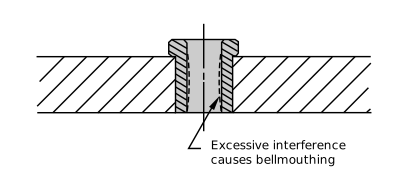
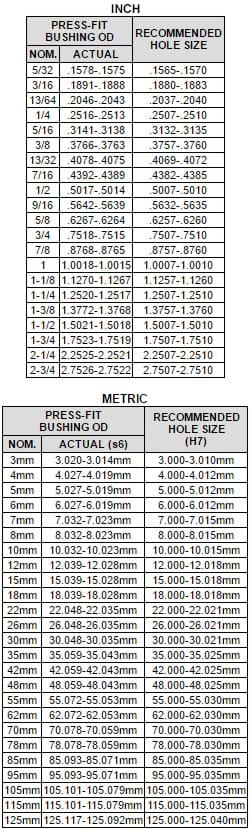
To avoid jig-plate or bushing baloney, exercise not use excessive interference fits on press-fit bushings. Run across tabular array below for recommended pigsty sizes in unhardened steel or cast iron jig plates. Always prepare installation holes using a jig borer or reamer. Standard chucking reamers (with a plus tolerance) commonly produce installation holes to the tolerances shown in the table. Other factors to consider are: (one) headed bushings require less interference to resist drilling thrust; (two) longer bushings in thick plates require less interference; (3) bushings with thinner walls are more prone to distortion; (4) less-ductile jig-plate materials require less interference.
Unground Bushings Available for Oversize Holes:
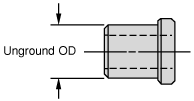
We offer bushings with unfinished ODs for custom-fitting to oversize holes. They are slightly larger than nominal bore to provide grinding stock, .005-.020 extra, depending on the OD size (see charts under each specific bushing type). Nosotros recommend grinding on a mandrel to hold ID/OD concentricity.
Installation Procedure:

We recommend installing bushings with an arbor printing whenever possible. If the bushing's OD is big enough, you can also utilize a drawbolt with ii washers as shown above. If a hammer is the only tool available, exercise not strike the bushing directly or it could fracture. Employ a soft-metal dial to cushion the blows. Before installing a press-fit bushing, lubricate the inside of the mounting hole and outside of the bushing with a lubricant such as lithium grease. Otherwise the bushing may score the mounting hole, and may exist difficult to replace later.
Ground Pb for Easy Installation:
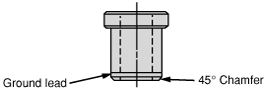
All bushings feature a concentric ground lead and a 45° chamfer on the exit end to ensure perfect alignment during installation.
Counterbores on Long Bushings:
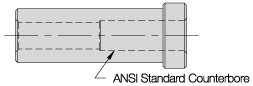
Long bushings with modest IDs are slightly counterbored for proper drill-bearing length and bit clearance, as specified past ANSI standards. Counterbores prevent binding and heat buildup due to excessive bearing length. Run into Counterbore Data charts for ANSI counterbore depths. Counterbore diameters are mostly one/32 inch larger than the inside diameter, and are angled at the bottom for smooth entrance. No-counterbore bushings are available on asking as specials.
Drill Entrance Radius:

Bushings characteristic a blended and polished radius at the drill-archway cease for shine drill entry and proper alignment, preventing drill wear and breakage. Radius size varies in proportion to drill size.
Concentricity:
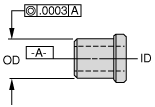
Bushing OD is basis concentric to the ID to within .0003 TIR for ID sizes from 1/8 inch to 1/ii inch (3mm to 12mm), unless otherwise indicated. For larger or smaller sizes, concentricity is inside .0005 TIR. Unground bushings are concentric to inside .006 TIR. On counterbored bushings, concentricity applies only over the drill-bearing length.
Other Tolerances:
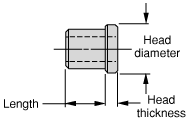
Whatsoever dimensions where tolerances are not specifically listed are held to +/-.015 inches on standard ANSI sizes. Special tolerances for any dimension are available on request every bit specials.
Cloth:
Standard drill-bushing textile is durable 1144 Stressproof steel, heat treated to accomplish RC 62-64 ID hardness, and other high-carbon steels. Optional materials such equally tungsten carbide (Grade C2 carbide with steel head), 52100 steel, A2 tool steel, D2 tool steel, M2 tool steel, 416 stainless, 440C stainless, 17-4PH stainless, 303 stainless, 660 bronze, Ampco eighteen bronze, Ampco 21 bronze, Oilite, and brass are available as specials.

Source: https://www.carrlane.com/engineering-resources/technical-information/manual-workholding/drill-bushings/installation-and-technical-data
Posted by: bagleytheinglee.blogspot.com
0 Response to "How To Install Bronze Bushings"
Post a Comment